Here’s the thing nobody tells you when you start house-hunting in Naperville: the school district can change halfway down a single street. Same sidewalk, same mail carrier, two different high schools. It’s the first question out of almost every Naperville buyer’s mouth (which district is “better?”), and the honest answer tends to annoy people, because it’s not the one they’re expecting.
So let’s get into it: the real differences between District 203 and District 204, where the lines actually fall, what it does to your tax bill and your price, and the one mistake that trips buyers up over and over.
First, the plot twist: the south side ranks higher
Most people roll into Naperville assuming the older, central-and-north part of town is the prestige pick: District 203, the one wrapped around the Riverwalk and downtown. It’s the Naperville on the postcards. Naperville Central, Naperville North, the historic homes near Centennial Beach.
It’s a great district. It’s just not the higher-ranked one.
As of Niche’s rankings, reported in October 2025 by NCTV17, District 204 (the south and southwest side) actually edges out 203: #36 nationally and #9 in Illinois, versus 203’s #51 and #11. Both earned an A+, so we’re splitting hairs at an elite level here. But if your whole plan was “buy north for the schools,” that assumption deserves a second look. Neuqua Valley High School, down in 204, is the highest-ranked public high school in the area (#11 in Illinois). Metea Valley isn’t far behind.
I’m not telling you to chase a ranking. I’m telling you the shorthand, north equals better schools, is too simplistic here, and buyers can overpay when they rely on it.
Who covers what
Let’s map it plainly, because the geography is half the confusion.
District 203 (Naperville Community Unit School District 203) covers central and north Naperville, plus a few slices of Lisle and Bolingbrook. Its two high schools:
- Naperville Central (downtown-adjacent, walkable to the historic district)
- Naperville North
District 204 (Indian Prairie School District 204) runs across the south and east/southwest, and it sprawls well past Naperville’s borders into Aurora, Bolingbrook, and Plainfield, crossing from DuPage County into Will. Its comprehensive high schools:
- Neuqua Valley
- Metea Valley
- Waubonsie Valley
That county detail matters more than it sounds. Hold that thought, because it comes back to bite the tax conversation in a minute.
Here’s the two of them side by side:
| District 203 | District 204 | |
|---|---|---|
| Where | Central & north Naperville (+ parts of Lisle, Bolingbrook) | South & southwest (+ Aurora, Bolingbrook, Plainfield) |
| High schools | Naperville Central, Naperville North | Neuqua Valley, Metea Valley, Waubonsie Valley |
| Niche district rank (Oct 2025) | #51 national / #11 IL · A+ | #36 national / #9 IL · A+ |
| Top local high school | Naperville North (#18 IL) | Neuqua Valley (#11 IL) |
| Counties | DuPage | DuPage and Will (tax differs by side) |
| Marquee subdivisions | Cress Creek, Hobson West, downtown/Historic District | White Eagle, Tall Grass |
| Metra (BNSF) | Naperville station (downtown) | Route 59 station |
Rankings: Niche, reported October 2025 (NCTV17). Both districts are A+. This is elite vs. elite.
The real takeaway isn’t that one district is “good” and the other “bad.” Both are strong. The real decision is lifestyle, commute, tax exposure, housing stock, and the specific school assignment tied to the exact address.
The mistake: trusting the map
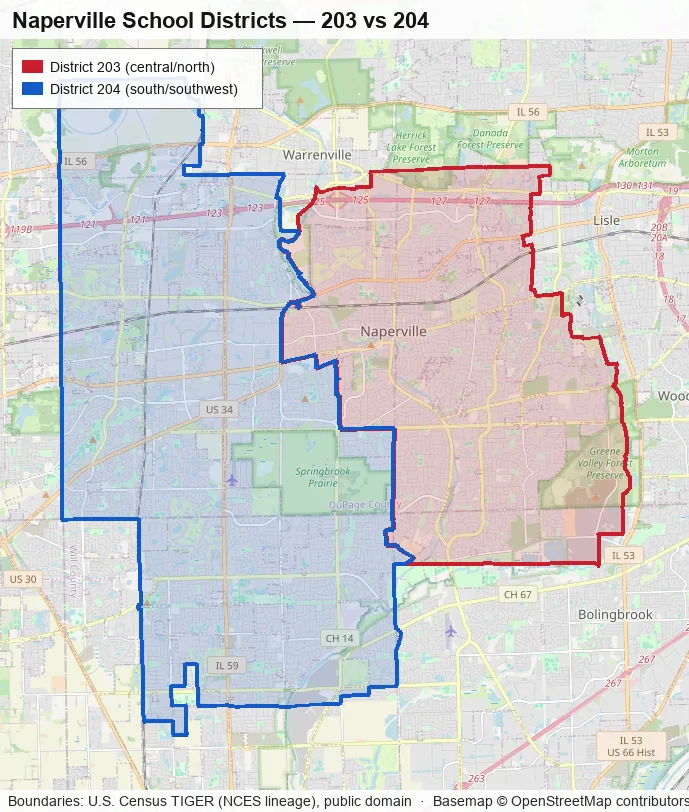
The 203/204 line through Naperville. District boundaries from NCES EDGE; basemap © OpenStreetMap contributors. Reference only. Confirm any specific address with the district.
This is the part I’d underline twice if I could.
District 204 publishes boundary maps. And on its own boundary and residency page, the district flat-out says those maps are “not definitive” and tells families to email residency@ipsd.org to confirm a specific address. Read that again: the district won’t fully stand behind its own map for a borderline home. That’s not them being difficult. Boundaries genuinely don’t follow ZIP codes, city limits, or any line you’d intuit from a drive-through.
So here’s what happens. A buyer falls for a house, sees a school name on the Zillow listing, assumes it’s settled, writes the offer. Closes. Then in August finds out the listing’s “school” was the portal’s best guess, and the actual assignment is a different building entirely, sometimes a different district.
Don’t be that buyer. If schools are driving your purchase and the home is anywhere near a boundary:
- For 204, email residency@ipsd.org with the exact address.
- For 203, call Centralized Enrollment at 630-548-4320 and check the attendance resources at naperville203.org.
Two emails. Five minutes. It’s the cheapest insurance in the entire transaction, and almost nobody does it before they’re already emotionally committed.
What it costs, and the tax trap most people miss
Naperville isn’t cheap, but it isn’t one price either. That’s the second thing the “what’s it cost” question gets wrong.
As of Redfin’s May 2026 data, the citywide median sits around $595K, with homes going in roughly 55 days. But the spread underneath that median is wide: the 60563 ZIP runs closer to the low $450s, 60565 lands in the mid $500s, 60540 pushes toward $600K, and the downtown core (small, tightly held, slow to turn over) medians up near $960K. “Naperville” covers a half-million-dollar range depending on which part you mean. Numbers move, so check the live figure before you lean on it.
Now the tax trap. Naperville’s effective property tax rate runs around 2%, call it 2.05% on the DuPage side, with a median bill in the neighborhood of $9,000 per Ownwell’s April 2026 data. For perspective, the national average is about 0.89%. You’re paying roughly two and a third times the typical American property tax rate. Buyers relocating from lower-tax states feel this one in the chest.
And here’s the kicker tied to that county detail from earlier. Because District 204 spans both DuPage and Will, Will County parcels can carry a different effective tax burden than nearby DuPage County parcels, so the monthly payment can change even when two homes look similar on paper. If you’re shopping the far south and southwest, confirm which county the parcel sits in, and check its tax history, before you fall in love with the monthly number.
So which side should you actually buy?
It depends entirely on what you’re optimizing for, and I’d push back on anyone who gives you a blanket answer.
Buy 203 (central/north) if you want the older, downtown-gravity Naperville:
- Central and north Naperville
- Walkable to downtown, the Riverwalk, the historic feel
- Older, leafier neighborhoods
- Cress Creek, Hobson West, the Historic District near Nichols Library
- The downtown Naperville Metra station
You’re paying for walkability and that classic Naperville feel, and plenty of people happily do.
Buy 204 (south/southwest) if you want newer construction and more house for the money:
- South and southwest Naperville
- Newer construction, more house for the dollar
- Neuqua Valley, Metea Valley, Waubonsie Valley
- White Eagle (a golf-course community feeding Neuqua) and Tall Grass (feeding Metea)
- The Route 59 Metra station
The trade-off is orienting your life around Route 59 and I-88 instead of downtown.
On commuting: both sides sit on the BNSF Metra line, the workhorse route into the city. The downtown Naperville station (105 E. 4th Ave) and the Route 59 station are both roughly an hour to Union Station, a bit quicker on an express. If a daily train commute is part of the math, check the actual BNSF schedule for your station, because “roughly an hour” hides a real gap between express and local runs.
The bottom line
If you remember nothing else, remember this: both districts are excellent, District 204 may surprise people on paper, school assignments can change block by block, and your tax bill can shift depending on which county the parcel sits in. Before you fall in love with the house, verify the address.
Researching a specific Naperville address or block? Send us the address before you write an offer. We’ll help you verify the school district, confirm which county it sits in, and understand what that could mean for your tax bill, using the district directly instead of relying on a listing portal’s guess.
Frequently asked questions
Is District 203 or District 204 better?
Both are highly rated. District 204 currently edges 203 in some rankings, but the better choice depends on the exact address, school assignment, commute, taxes, and lifestyle fit.
Can two Naperville homes on the same street be in different districts?
Yes. Boundaries don’t always follow ZIP codes, city limits, or neighborhood assumptions. Buyers should verify the exact address directly with the district.
How do I confirm the school district for a Naperville home?
For District 204, contact the district residency office with the exact address. For District 203, use the district’s attendance resources or contact Centralized Enrollment.
Does District 204 include areas outside Naperville?
Yes. District 204 serves parts of Naperville and also extends into nearby communities including Aurora, Bolingbrook, and Plainfield.
Do Naperville property taxes change by county?
They can. Naperville includes parcels in different counties, and effective tax rates can vary. Buyers should confirm the county and parcel tax history before making an offer.
Keep reading
- Naperville property taxes: what buyers actually pay
- What $800K, $1M, and $1.5M buy in Naperville
- Living in Naperville: the complete buyer guide
About Chicago Estates Co
We focus on Chicago’s western suburbs: Naperville, Hinsdale, Downers Grove, Oak Brook, and the towns around them. These guides come from close, current research into the specific markets we cover, including school boundaries, tax rolls, and real sale prices, with one goal: straight answers most real-estate sites won’t give you.
Last updated: June 2026. We refresh this guide as rankings, prices, and boundaries change. The school and tax figures above are dated to their sources.
Get the next guide before you tour
We publish a new western-suburbs buyer guide and monthly market notes — the school, tax, and price facts for each town. Get them by email.
Free. No spam. Unsubscribe anytime.
You’re in. Your first update lands this week.
Shopping in the $900K+ luxury tier? Visit our sister site, Luxury List Chicago ›
Photo: “NCHS Symphonic Band Concert & Sightreading - 4-24-18 (40790170785)” by Jill Carlson (jillcarlson.org) from Roman Forest, Texas, USA, CC BY 2.0, via Wikimedia Commons. Source: source